Tag archives: Guitar Making

Nitrocellulose Lacquers

One of the preferred lacquers in guitar making is Nitrocellulose Lacquers. It is one of the more safe lacquers to use compared to the catalyzed lacquers that often contain formaldehyde which are banned in most first world countries. The advantage of nitrocellulose lacquers is that when you apply your layers, there is a chemical bond between coats. If some damage occurs to the finish at some stage, it is easier to repair compared to catalyzed lacquers, in that, the layer can be softened with a solvent, whereas the catalyzed cannot. Nitrocellulose can also be rubbed with a pad like the French Polishing technique to help close the grain of the wood and to help create a fine finish. Below is some more detailed information specific to Nitrocellulose.DSCF0297.....

Lacquer is a clear or coloured wood finish that dries by solvent evaporation or a curing process that produces a hard, durable finish. This finish can be of any sheen level from ultra matte to high gloss, and it can be further polished as required. It is also used for "lacquer paint", which typically is a paint that dries to a more than usually hard and smooth surface.

Quick-drying solvent-based lacquers that contain nitrocellulose a resin obtained from the nitration of cotton and other cellulostic materials, were developed in the early 1920s, and extensively used in the automobile industry for 30 years. Prior to their introduction, mass-produced automotive finishes were limited in colour, with Japan Black being the fastest drying and thus most popular. General Motors Oakland automobile brand automobile was the first (1923) to introduce one of the new fast drying nitrocelluous lacquers, a bright blue, produced by DuPont under their Duco tradename.

These lacquers are also used on wooden products, furniture primarily, and on musical instruments and other objects. Nitrocellulose lacquers are also used to make firework fuse waterproof. The nitrocellulose and other resins and plasticizers are dissolved in the solvent, and each coat of lacquer dissolves some of the previous coat. These lacquers were a huge improvement over earlier automobile and furniture finishes, both in ease of application and in colour retention. The preferred method of applying quick-drying lacquers is by spraying, and the development of nitrocellulose lacquers led to the first extensive use of spray guns. Nitrocellulose lacquers produce a hard yet flexible, durable finish that can be polished to a high sheen. Drawbacks of these lacquers include the hazardous nature of the solvent, which is flammable and toxic, and the hazards of nitrocellulose in the manufacturing process. Lacquer grade of soluble nitrocellulose is closely related to the more highly nitrated form which is used to make explosives. They become relatively non-toxic after approximately a month since at this point, the lacquer has evaporated most of the solvents used in its production.

Fibonacci Numbers and the Golden Ratio

Fibonacci 1Leonardo Fibonacci was a mathematician who lived in the early 1200's. He discovered a sequence of numbers that relates to all of nature as well as the golden section.

In mathematics, the Fibonacci numbers or Fibonacci sequence are the numbers in the following integer sequence

Fibonacci Sequence 1

or (often, in modern usage):

Fibonacci Sequence 2

The pattern to get the numbers is starting at the lowest number, from the left, add the first two numbers and that will give you the third number. Add the second and the third number and that will give you the fourth number and so on ie 0+1=1; 1+1=2; 1=2+3; 2=3+5 ;

Now, if you divide any two of the numbers, you will find that the answer will get closer and closer to either 0,618a or 1,618a, depending which way you divide, which is the ratio in the golden section. (The Fibonacci sequence gets closer and closer to a Golden Spiral as it increases in size because of the ratio of each number in the Fibonacci series to the one before it converges on Phi, 1.618, as the series progresses (e.g., 1, 1, 2, 3, 5, 8 and 13 produce ratios of 1, 2, 1.5, 1.67, 1.6 and 1.625, respectively)

The Fibonacci numbers are Nature's numbering system. They appear everywhere in Nature, from the leaf arrangement in plants, to the pattern of the florets of a flower, the bracts of a pinecone, or the scales of a pineapple. The Fibonacci numbers are therefore applicable to the growth of every living thing, including a single cell, a grain of wheat, a hive of bees, and even all of mankind.

Let's look first at the Rabbit Puzzle that Fibonacci wrote about and then at two adaptations of it to make it more realistic. This introduces you to the Fibonacci Number series and the simple definition of the whole never-ending series.

Fibonaccia's RabbitsFibonacci Rabbits

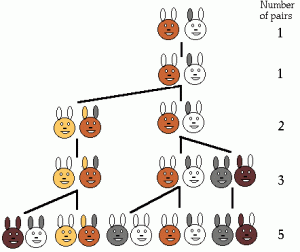
The original problem that Fibonacci investigated (in the year 1202) was about how fast rabbits could breed in ideal circumstances. Suppose a newly-born pair of rabbits, one male, one female, are put in a field. Rabbits are able to mate at the age of one month so that at the end of its second month a female can produce another pair of rabbits. Suppose that our rabbits never die and that the female always produces one new pair (one male, one female) every month from the second month on. The puzzle that Fibonacci posed was...

How many pairs will there be in one year?

  1. At the end of the first month, they mate, but there is still one only 1 pair.
  2. At the end of the second month the female produces a new pair, so now there are 2 pairs of rabbits in the field.
  3. At the end of the third month, the original female produces a second pair, making 3 pairs in all in the field.
  4. At the end of the fourth month, the original female has produced yet another new pair, the female born two months ago produces her first pair also, making 5 pairs
Fibonacci 3

Seed Heads

Fibonacci numbers can also be seen in the arrangement of seeds on flower heads.Fibonacci 4
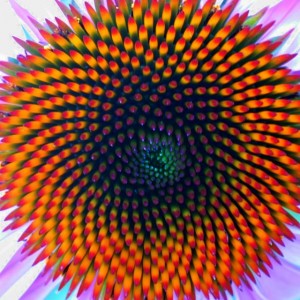
You can see that the orange "petals" seem to form spirals curving both to the left and to the right. At the edge of the picture, if you count those spiralling to the right as you go outwards, there are 55 spirals. A little further towards the centre and you can count 34 spirals. How many spirals go the other way at these places? You will see that the pair of numbers (counting spirals in curing left and curving right) are adjacent numbers in the Fibonacci series.

The same happens in many seed and flower heads in nature. The reason seems to be that this arrangement forms an optimal packing of the seeds so that, no matter how large the seed head, they are uniformly packed at any stage, all the seeds being the same size, no crowding in the centre and not too sparse at the edges.

The spirals are patterns that the eye sees, "curvier" spirals appearing near the centre, flatter spirals (and more of them) appearing the farther out we go.

So the number of spirals we see, in either direction, is different for larger flower heads than for small. On a large flower head, we see more spirals further out than we do near the centre. The numbers of spirals in each direction are (almost always) neighbouring Fibonacci numbers!

Plants do not know about this sequence - they just grow in the most efficient ways. Many plants show the Fibonacci numbers in the arrangement of the leaves around the stem. Some pine cones and fir cones also show the numbers, as do daisies and sunflowers. Sunflowers can contain the number 89, or even 144. Many other plants, such as succulents, also show the numbers. Some coniferous trees show these numbers in the bumps on their trunks. And palm trees show the numbers in the rings on their trunks. In the seeming randomness of the natural world, we can find many instances of mathematical order involving the Fibonacci numbers themselves and the closely related "Golden" elements.

Humans and Spirals

Humans exhibit Fibonacci characteristics, too. The Golden Ratio is seen in the proportions in the sections of a finger.

Fibonacci 6

  • It is also worthwhile to mention that we have 8 fingers in total, 5 digits on each hand,3 bones in each finger,2 bones in 1 thumb, and 1 thumb on each hand.
  • The ratio between the forearm and the hand is the Golden Ratio!


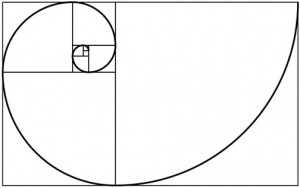
Fibonacci spirals and Golden spirals appear in nature, but not every spiral in nature is related to Fibonacci numbers or Phi (Golden Ratio - 0,618.). We also use these principles in things we do and make, even in musical instruments, in guitar making and violin making, etc.Most spirals in nature are equiangular spirals, and Fibonacci and Golden spirals are special cases of the broader class of Equiangular spirals. An Equiangular spiral itself is a special type of spiral with unique mathematical properties in which the size of the spiral increases but its shape remains the same with each successive rotation of its curve.  The curve of an equiangular spiral has a constant angle between a line from origin to any point on the curve and the tangent at that point, hence its name.  In nature, equiangular spirals occur simply because they result in the forces that create the spiral are in equilibrium, and are often seen in non-living examples such as spiral arms of galaxies and the spirals of hurricanes.  Fibonacci spirals, Golden spirals and golden ratio-based spirals generally appear in living organisms, as illustrated below:
Fibonacci 7

Fibonacci 8A�A�A�A�A�A�A�A�A�A�A�A�A�A�A�A�A�A�A�A�A�A�A�A�A� Fibonacci 9

Oldest Stringed Instruments

Oldest Stringed Instrument Still Producing Music


It is always interesting to look back on some of the things we have and use today and try and trace back their origins. I was interested in when we first started using wood veneer, thinking that veneering was quite recent (say a couple of hundred years) a to my amazement veneers have been discovered in the pyramids a bit thicker than the standard today, but there nonetheless.

With violin making, guitar making, harps ie stringed instruments when did we start trying our hands at these I found this bit of interesting info on China.org.

  
A 25-stringed musical instrument, said to be made several hundred years ago, was recently found in Yi Autonomous County of Weishan, southwest China 's Yunnan Province.This may be the oldest musical instrument that has ever been discovered in the world which still produces music, according to professor Cao Zheng and other experts from the Central Conservatory of Music. Cao is an expert of Zheng, a Chinese zither with 25 strings.

The instrument, two meters long, is bigger and has more strings than other similar instruments that have been found in other parts of China, experts said.

They explained, the instrument, called "Se" in Chinese, produces a grand and deep sound. Playing the "Se" began flourishing in the Spring and Autumn Period (BC770-BC476) and the Warring States (BC475-BC221).

Weishan, belonging to the Bai Autonomous Prefecture of Dali, was the capital of Nanzhao State in the Tang Dynasty (618-907) and an important cultural city on the southwest Silk Road.

The county has more than 3,000 state-level relics.


Careers and Changes

Choosing a career is a stressful decision, especially when you are at a school leaving age. At seventeen or eighteen years old, how does one know what you would like to do job wise for the rest of your life, that you will be content and happy with many of us, at the age of between forty and sixty, still don't know what we want to do.you could try guitar making.

Below is and interesting part of an article where a study was done in 2008 on career changing. There are a number of people, who, at the age of between thirty upwards are not in the career they chose or studied. In the statistics below, this makes up the second largest percentage of people changing careers. Why is this, what makes us want to leave or change the job we have? This is an extremely broad and controversial subject, one that someone could write a thesis on.

Thinking Man

Career changing (occupation)

Changing occupation is an important aspect of career and career management. Over a lifetime, both the individual and the labour market will change; it is to be expected that many people will change occupations during their lives. Data collected by the U.S. Bureau of Labor Statistics through the National Longitudinal Survey of Youth in 1979 showed that individuals between the ages of 18 and 38 will hold more than 10 jobs. Imagine what that number is today!

A survey conducted by Right Management (May 2008) suggests the following reasons for career changing.

  • The downsizing or the restructuring of an organization (54%).
  • New challenges or opportunities that arise (30%).
  • Poor or ineffective leadership (25%).
  • Having a poor relationship with a manager(s) (22%).
  • For the improvement of work/life balance (21%).
  • Contributions are not being recognized (21%).
  • For better compensation and benefits (18%),
  • For better alignment with personal and organizational values (17%).
  • Personal strengths and capabilities are not a good fit with an organization (16%).
  • The financial instability of an organization (13%).
  • An organization relocated (12%).

According to an article on Time.com, one out of three people currently employed (as of 2008) spends about an hour per day searching for another position.

So, when you feel like changing your job, for whatever reason, as many of us do, you are quite normal!


The Tamboti Tree - Spirostachys Africana

Spirostachys africana is a medium-sized (about 10 metres tall) deciduous tree with a straight, clear trunk, occurring in the warmer parts of Southern Africa. Its wood is known as tamboti, tambotie, tambootie or tambuti. This wood if used in guitar making, would possibly be used for a bridge, however, the wood has a very high natural oil content and sometime poses some gluing problems. Normally in furniture making, a joint with some kind of a locking system, like a pinned mortise and tennon joint in conjunction with the glue.

It prefers growing in single-species copses in deciduous woodland, often along watercourses or on brackish flats and sandy soils.Tamboti 1

The leaves are small, elliptic with crenate margins, and turn bright red in winter before dropping. The petiole has 2 small glands at the distal end. The grey-black rough bark is distinctively split into neat rectangles. The catkin-like flowers appear in early spring before the leaves. Male and female flowers are borne separately on the same tree (monoecious). The small 3-lobed capsules or schizocarps split into three equal indehiscent segments (mericarps or cocci) when ripe; on a warm day this splitting (dehiscence) can sound like a distant fusillade of shots. The seeds are globose with a chartaceous testa.

Wood and toxicity

Despite its being prone to heart-rot, it is prized in the furniture industry for its beautiful, dense and durable timber, which is reddish-brown with darker streaks, a satin-like lustre and extremely fragrant sweet, spicy smell. The underbark exudes a white, poisonous latex when freshly cut, and campfires that burn tambuti fuel give off noxious fumes contaminating meat or other food grilled on the flames or coals. The latex can cause severe illness if the wood is used as fuel to cook. The latex is used as a fish poison, is applied to arrow-tips and is used as a purgative by indigenous tribes.

Tamboti 2

Links with animals - The fruit is eaten by crested guineafowl, francolin and doves. Black rhino eat the young branches. Dry fallen leaves are eaten by kudu, nyala, impala and vervet monkeys.

Human uses - The wood is very valuable and used to manufacture exceptional furniture. The poisonous lates is used to stupefy fish, for easier catching, and the sap to treat toothache.

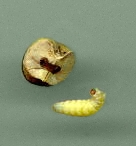
Jumping beans (africana mericarp with Emporia melanobasis larva).Tamboti - Jumping Bean

The fruits while green are frequently parasitised by the small grey moth Emporia melanobasis (Pyralidae: Phycitinae). Larvae develop within the growing fruits which show no external damage. When the fruits are mature each splits into 3 cocci. The larvae jack-knife inside the fallen segments, causing them to move about erratically and vigorously, to the surprise of the uninitiated. This has led to the name "Jumping Bean Tree".

Best places to see the Tamboti in Southern Africa

The Tamboti is found in the Kruger National Park in the Mixed Bushwillow Woodlands, Pretoriuskop Sourveld, Malelane Mountain Bushveld, Sabie Crocodile Thorn Thickets, Delagoa Thorn Thickets, Riverine Communities, Alluvial Plains, Tree Mopane Savannah & Mopane / Bushwillow Woodlands ecozones.