The Empire State Building is a 103-story skyscraper located in Midtown Manhattan, New York City, at the intersection of Fifth Avenue and West 34th Street. It has a roof height of 1,250 feet (380m), and with its antenna spire included, it stands a total of 1,454 feet (443m) height. Its name is derived from the nickname for New York, the Empire State. It stood as the world's tallest building for nearly 40 years, from its completion in early 1931 until the topping out of the original World Trade Center's North Tower in late 1970. Following the September 11 attacks in 2001, the Empire State Building was again the tallest building in New York (although it was no longer the tallest in the US or the world), until One World Trade Center reached a greater height on April 30, 2012. The Empire State Building is currently the fourth-tallest completed skyscraper in the United States (after the One World Trade Center, the Willis Tower and Trump International Hotel and Tower, both in Chicago), and the 25th-tallest in the world (the tallest now is Burj Khalifa, located in Dubai). It is also the fifth-tallest freestanding structure in the Americas.
The Empire State Building is generally thought of as an American cultural icon. It is designed in the distinctive Art Deco style and has been named as one of the Seven Wonders of the Modern World by the American Society of Civil Engineers. The building and its street floor interior are designated landmarks of the New York City Landmarks Preservation Commission, and confirmed by the New York City Board of Estimate. It was designated as a National Historic Landmark in 1986. In 2007, it was ranked number one on the AIA's List of America's Favorite Architecture.
The building is owned by the Empire State Realty Trust, for which Anthony Malkin serves as Chairman, CEO and President. In 2010, the Empire State Building underwent a $550 million renovation, with $120 million spent to transform the building into a more energy efficient and eco-friendly structure. Receiving a gold Leadership in Energy and Environmental Design (LEED) rating in September 2011, the Empire State Building is the tallest LEED certified building in the United States.
The Empire State Building was designed by William F. Lamb from the architectural firm Shreve, Lamb and Harmon, which produced the building drawings in just two weeks, using its earlier designs for the Reynolds Building in Winston-Salem, North Carolina, and the Carew Tower in Cincinnati, Ohio (designed by the architectural firm W. W. Ahlschlager & Associates) as a basis.
Excavation of the site began on January 22, 1930, and construction on the building itself started symbolically on March 17a St. Patrick's Dayaper Al Smith's influence as Empire State, Inc. president. The project involved 3,400 workers, mostly immigrants from Europe, along with hundreds of Mohawk iron workers, many from the Kahnawake reserve near Montreal. According to official accounts, five workers died during the construction.[29] Governor Smith's grandchildren cut the ribbon on May 1, 1931. Lewis Wickes Hine's photography of the construction provides not only invaluable documentation of the construction, but also a glimpse into common day life of workers in that era.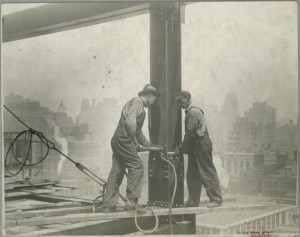
The construction was part of an intense competition in New York for the title of "world's tallest building". Two other projects fighting for the title, 40 Wall Street. and the Chrysler Building, were still under construction when work began on the Empire State Building. Each held the title for less than a year, as the Empire State Building surpassed them upon its completion, just 410 days after construction commenced. Instead of taking 18 months as anticipated, the construction took just under fifteen.
Aircraft Incident
At 9:40 am on Saturday, July 28, 1945, a B-25 Mitchell bomber, piloted in thick fog by Lieutenant Colonel William Franklin Smith, Jr., crashed into the north side of the Empire State Building, between the 79th and 80th floors, where the offices of the National Catholic Welfare Council were located.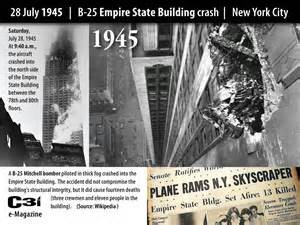 One engine shot through the side opposite the impact and flew as far as the next block, where it landed on the roof of a nearby building, starting a fire that destroyed a penthouse. The other engine and part of the landing gear plummeted down an elevator shaft. The resulting fire was extinguished in 40 minutes. Fourteen people were killed in the accident. Elevator operator Betty Lou Oliver survived a plunge of 75 stories inside an elevator, which still stands as the Guinness World Record for the longest survived elevator fall recorded. Despite the damage and loss of life, the building was open for business on many floors on the following Monday. The crash helped spur the passage of the long-pending Federal Tort Claims Act of 1946, as well as the insertion of retroactive provisions into the law, allowing people to sue the government for the accident.
A year later, another aircraft narrowly missed striking the building.

What is interesting is that if we look at our strict health and safety rules that apply today in our current work places, imagine if the work ethics and conditions of these workers on the Empire State building suddenly appeared on a building site today..?
 This is done by cutting a rebate into the edge, either with a router, or as was done more traditionally in the past, by hand, with a rebate tool. Next to the binding, a strip of purfling is usually inlayed in along with the binding. Purfling strips are thin laminate pieces of different woods or woods dyed different colours. The purfling on guitars is usually more for aesthetic purposes.
 When the bindings are glued into position, again, the gluing area has been increased to strengthen the joint even more. It protects the fragile, grain edges of the top and back while helping attach them to the sides.


